Mini Farmhouses – Charming and Functional Small-Scale Homes
Mini farmhouses sit at the crossroads of comfort, efficiency, and a growing desire for simpler living. They give homeowners the warmth of rural design without the expense, upkeep, or acreage often linked to a traditional farmhouse. In a housing market shaped by rising prices, downsizing trends, and remote work, these compact homes feel increasingly relevant. This article looks at how small-scale farmhouse living can blend beauty, flexibility, and everyday practicality in one thoughtfully designed space.
Outline:
- What defines a mini farmhouse and why this housing style matters today
- Why Mini Farmhouses – Charming and Functional Small-Scale Homes continue to attract modern homeowners
- The design features that make a small home feel open, useful, and welcoming
- Costs, land planning, energy performance, and long-term maintenance
- Who these homes suit best, plus practical guidance for choosing the right approach
What Mini Farmhouses Are and Why They Matter
A mini farmhouse is not simply a tiny house with rustic decor. In most cases, it is a small-scale home that borrows the visual language of a farmhouse while keeping a more manageable footprint. Many fall somewhere between roughly 400 and 1,200 square feet, though the exact size varies by region, budget, and building code. That makes them notably smaller than the average newly built single-family home in the United States, which has commonly measured well above 2,000 square feet in recent years. The difference is more than numerical. A mini farmhouse represents a different way of thinking about space, ownership, and daily life.
Part of the appeal comes from balance. Traditional farmhouses are admired for their honesty: simple rooflines, durable materials, useful porches, and rooms shaped around work and family life. Mini versions keep that spirit but adapt it to modern needs. A young couple may want lower mortgage pressure. Retirees may be tired of cleaning rooms they no longer use. Remote workers may prefer a compact home on a small piece of land rather than a large house in a crowded subdivision. In each case, the goal is not deprivation. It is focus.
There is also a cultural reason these homes resonate. Many people feel pulled toward a slower, more tactile way of living, even if they do not plan to run a farm or move far into the countryside. A mini farmhouse suggests mornings with natural light, shelves lined with practical storage, and a home that invites use instead of performance. It offers character without demanding excess.
Functionally, smaller homes often bring measurable benefits. They typically require fewer building materials, lower utility use, and less maintenance time than larger houses. Heating and cooling a compact, well-insulated home is generally easier than managing a sprawling floor plan. Insurance, furnishing, and repair costs may also be lower, though this depends on location and specification.
Still, small does not automatically mean easy. Poor layout choices can make a compact home feel crowded fast. That is why understanding the concept matters before anyone falls in love with shiplap walls or a metal roof. The best mini farmhouses succeed because every square foot is intentional. They are modest in scale, but when planned well, they feel complete rather than compromised.
Design Principles That Make Small Farmhouses Feel Bigger and Better
Good mini farmhouse design is less about decoration and more about disciplined planning. A successful layout makes a small home feel calm, not compressed. That usually starts with reducing wasted circulation space. Long hallways, oversized foyers, and isolated rooms consume square footage without improving daily life. In a mini farmhouse, the most effective plans often center on an open kitchen, dining, and living area, with private rooms kept compact and purposeful. The result is a home that feels sociable, bright, and efficient.
Ceiling height plays an outsized role. Even when the footprint is modest, a vaulted or slightly raised ceiling can create visual generosity. Windows matter just as much. Farmhouse-inspired homes often use symmetrical facades and tall windows, and in a smaller plan, that daylight helps every room feel more expansive. When light moves well through a house, the boundaries of the room soften. Suddenly, a compact living area feels intentional instead of tight.
Storage is where smart design earns its keep. Without a strategy, small homes become cluttered quickly. Built-in benches, under-stair cabinets, tall pantry units, and multi-use furniture can recover valuable space that would otherwise disappear. A good mini farmhouse does not apologize for being small; it edits life with confidence.
Design choices that often work especially well include:
- Simple rectangular or L-shaped plans that are easier and often cheaper to build
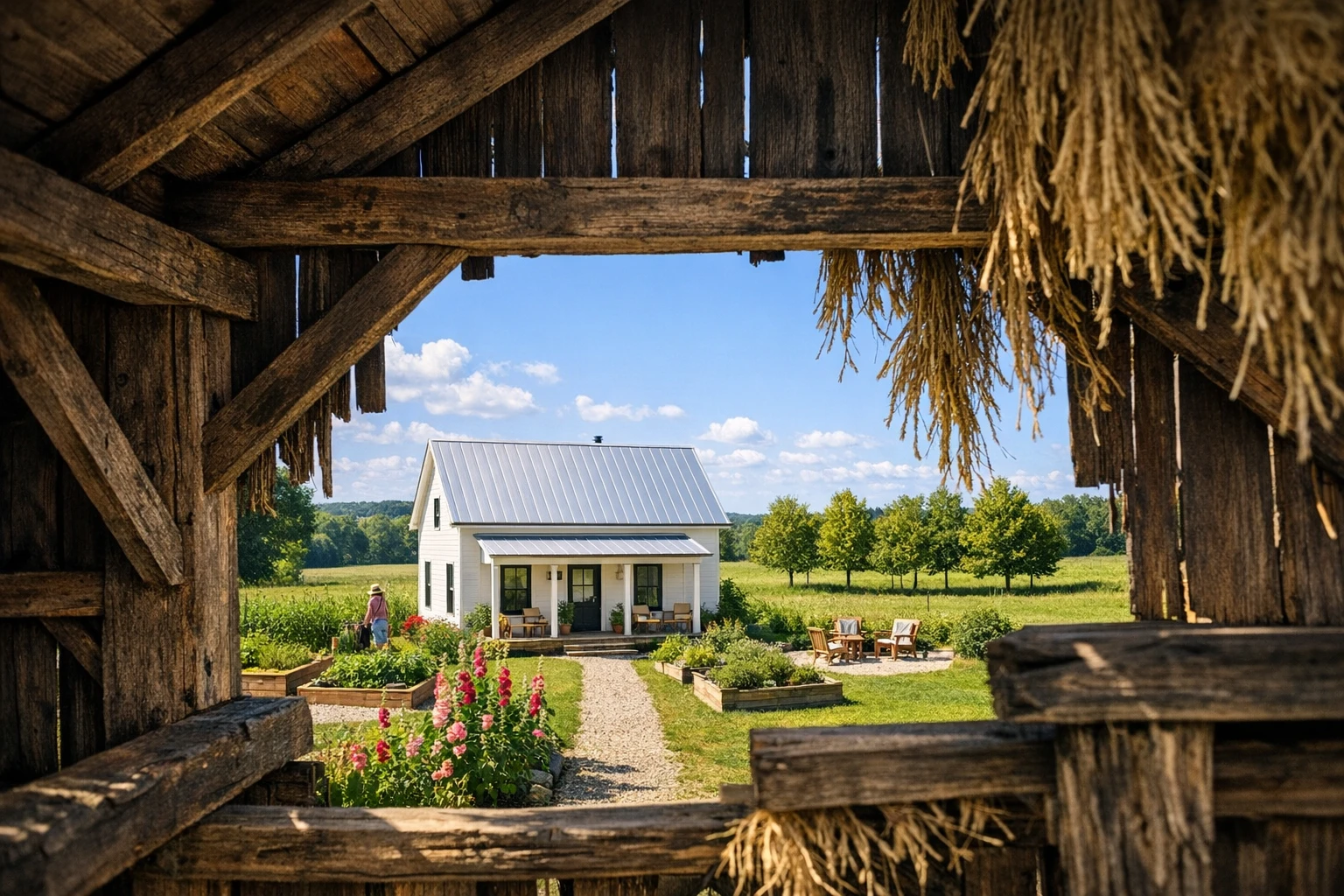
- Covered porches that extend living space outdoors
- Mudroom-style entry zones for shoes, coats, tools, and pet supplies
- Open shelving used selectively, balanced with closed storage to reduce visual clutter
- Lofts or flex rooms, but only where ceiling height and accessibility make sense
Material selection also shapes the experience. Board-and-batten siding, painted wood, durable fiber cement, metal roofing, butcher-block counters, and natural-toned flooring can all support the farmhouse look. Yet the goal should not be imitation for its own sake. A modern mini farmhouse can mix traditional elements with contemporary efficiency, such as high-performance windows, induction cooking, or low-maintenance composite porch decking.
Compared with many urban apartments, mini farmhouses often offer stronger indoor-outdoor connection and more control over layout. Compared with a full-size farmhouse, they demand sharper prioritization. That trade-off is the heart of the appeal. When every room has a job and every detail supports daily use, a smaller home can feel not smaller, but smarter.
Costs, Land Planning, and the Economics of Building Small
One of the biggest reasons people explore mini farmhouses is cost, but the financial picture deserves a realistic look. A smaller home usually costs less overall than a much larger one, yet it does not always have a lower cost per square foot. In many markets, compact custom homes can be relatively expensive on a per-square-foot basis because kitchens, bathrooms, mechanical systems, and site work still carry fixed costs. Depending on region, labor, finishes, and complexity, construction may range broadly from around 120 dollars to more than 300 dollars per square foot. Prefabricated models may reduce some expenses, while highly customized builds can push costs up quickly.
Land and infrastructure also shape the final budget. A rural site can look affordable at first glance, but well drilling, septic installation, utility hookups, grading, driveway access, and permit fees may add substantial amounts before the home itself is finished. On an infill lot near a town, the land may cost more, but services might already be available. In other words, the house is only part of the equation.
Common cost drivers include:
- Site preparation, drainage, and foundation type
- Local building codes, engineering, and permit requirements
- Custom cabinetry, premium windows, and decorative finishes
- Roof complexity, porch size, and exterior material choices
- Distance from suppliers and contractor availability
Where mini farmhouses often shine is over time. Smaller homes generally need less paint, fewer flooring materials, fewer light fixtures, and less furniture. Utility bills can be lower, especially when the structure is airtight and paired with modern insulation, efficient windows, and a right-sized HVAC system. Heat pumps, LED lighting, and Energy Star appliances can make a noticeable difference. Water-saving fixtures and thoughtful landscaping may trim consumption further.
Sustainability is not automatic, but smaller scale gives owners a head start. Less floor area usually means lower material demand and reduced operational energy use. A compact home can also support passive design choices more easily, such as orienting living spaces to capture winter sun or placing overhangs to reduce summer heat gain. Rainwater collection, solar panels, and native planting may be practical additions in some locations, subject to local rules.
The key comparison is this: a mini farmhouse is often more affordable to own than a larger detached house, but not always cheaper than an apartment or older resale home in the same area. Buyers should calculate total project cost, not just charm per square foot. The smartest decision blends romance with spreadsheets.
Everyday Living in a Mini Farmhouse: Flexibility, Comfort, and Real Limits
The real test of any home is not how it looks in photographs but how it behaves on a Tuesday morning. Mini farmhouses perform well when they align with the routines of the people living in them. For singles and couples, they can feel spacious enough while remaining easy to maintain. For retirees, they often reduce stairs, cleaning time, and monthly overhead. For remote workers, a compact plan with one dedicated office nook can be far more satisfying than paying for unused rooms elsewhere. For small families, the experience depends heavily on layout, storage discipline, and access to outdoor space.
One reason these homes feel livable is that farmhouse design has always valued useful transitions. A covered porch becomes a social buffer between indoors and outdoors. A mudroom wall with hooks and cubbies turns chaos into order. A generous kitchen island can function as prep area, dining spot, homework station, and conversation hub. In a larger house, these overlaps may go unnoticed. In a mini farmhouse, they become essential.
There are also lifestyle advantages that rarely appear on a floor plan. Cleaning a smaller home takes less time. Furnishing it well is usually more affordable than filling a large house with temporary pieces. Maintenance feels more manageable because the scale stays human. Many owners describe a sense of relief in living with fewer possessions and more intentional routines. The house becomes a tool rather than a burden.
Still, there are real limitations. Privacy can be harder to create, especially in loft-based layouts. Families with older children may outgrow a compact plan faster than expected. Storage requires discipline, not wishful thinking. Accessibility matters too. Loft ladders, narrow stairs, and tight bathrooms can become daily frustrations or future obstacles. Anyone planning to age in place should think carefully about one-level living, wider doorways, step-free entries, and shower design from the beginning.
Mini farmhouses can also serve beyond primary residence use. They work well as guesthouses, accessory dwelling units, weekend retreats, or long-term downsizing homes. In some regions, they are used for multigenerational living, giving older parents independence while keeping them near family. Others use them as semi-rural bases with gardens, workshops, or hobby spaces nearby. Their strength lies in adaptability.
Compared with a tiny house on wheels, a mini farmhouse often offers more comfort, code compliance, and daily practicality. Compared with a conventional large home, it asks for selectivity. That is the trade: less room for accumulation, more room for intention.
Is a Mini Farmhouse Right for You? Final Thoughts for Future Owners
If you are drawn to mini farmhouses, the first question is not whether the style is attractive. It probably is. The better question is whether the format matches the life you want to build over the next five to ten years. A compact farmhouse can be a smart move for first-time buyers trying to control costs, for downsizers who want ease without losing character, for remote workers seeking a quieter base, or for landowners adding a secondary dwelling. It can also disappoint if chosen for the wrong reasons, especially when people confuse aesthetic appeal with practical fit.
Before committing, it helps to make a short decision checklist:
- How much indoor space do you truly use now, not just imagine using?
- Do local zoning rules allow the size, placement, and purpose you have in mind?
- Will your storage needs fit the design without constant overflow?
- Can the layout adapt if work, family size, or mobility needs change?
- Have you budgeted for land, utilities, permits, landscaping, and furnishing, not only construction?
It is also wise to study examples that resemble your real situation. A weekend getaway can tolerate quirks that would be irritating in a full-time home. A one-bedroom cottage may suit a couple beautifully but strain under family life. A loft may look romantic until climbing to bed every night stops feeling charming. Practical touring, realistic measurements, and honest conversation beat mood boards every time.
For many buyers, the strongest argument in favor of a mini farmhouse is not merely lower cost. It is the quality of life that can come from a well-proportioned home. Less maintenance can mean more free time. Smaller rooms can feel warmer and easier to personalize. A porch, a garden path, a compact kitchen, and a bright living room can create a home that feels rooted rather than oversized. There is a quiet confidence in living within a footprint that supports your routines instead of dominating them.
For readers considering a build, renovation, or purchase, the takeaway is straightforward. Choose a mini farmhouse if you value function, atmosphere, and manageable ownership more than raw square footage. Plan carefully, design honestly, and let the house serve your life rather than your image. When those priorities line up, a small-scale farmhouse can offer not just shelter, but a deeply satisfying way to live.