Mini Farmhouses – Charming and Functional Small-Scale Homes
Mini farmhouses answer a modern question with an old-fashioned kind of wisdom: how much home do people really need to live well? As land prices climb, energy costs matter more, and many buyers rethink oversized houses, smaller farmhouse-inspired dwellings offer comfort, personality, and practical efficiency in one compact footprint. They blend rural warmth with smart planning, making them relevant to homeowners, downsizers, weekend builders, and anyone drawn to simpler living without giving up style.
Outline
- What a mini farmhouse is, and how it differs from a tiny house, cottage, or standard suburban home
- The design language behind the style, including layout strategies, storage planning, and architectural details
- Construction choices, energy performance, materials, and realistic budget considerations
- How mini farmhouses support different lifestyles, from full-time living to guest houses and rural retreats
- Practical advice for readers who want to build, buy, furnish, or adapt one successfully
What Defines a Mini Farmhouse?
A mini farmhouse is not simply a tiny house wearing rustic clothing. It is a small-scale home that borrows from farmhouse architecture and rural practicality while adapting to modern expectations around comfort, efficiency, and flexible living. In most cases, these homes fall somewhere between roughly 400 and 1,200 square feet, although local building rules, lot sizes, and owner preferences can shift that range. What matters more than the exact number is the design philosophy: every room should earn its place, and every feature should combine usefulness with visual warmth.
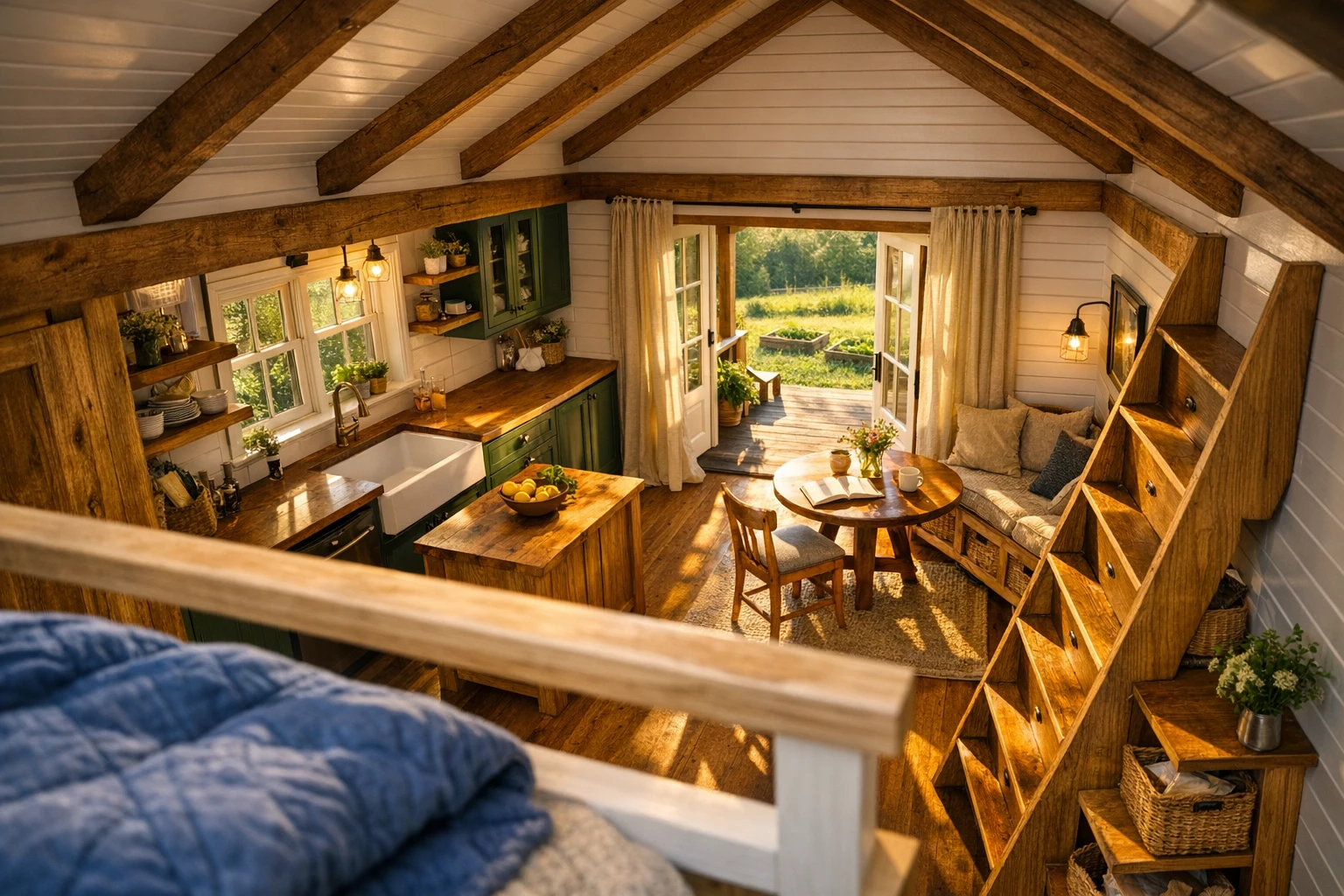
Traditional farmhouses were built to be durable, adaptable, and straightforward. They often featured simple rectangular forms, gable roofs, generous windows, mudroom-like entry spaces, and porches that functioned as transition zones between indoors and outdoors. Mini versions keep many of those traits but scale them down intelligently. Instead of a sprawling house with little-used formal rooms, the mini farmhouse tends to favor an open living area, compact kitchen, efficient bath layout, and one or two carefully planned sleeping zones. The result feels welcoming rather than cramped when the proportions are done well.
That is one reason the idea behind Mini Farmhouses – Charming and Functional Small-Scale Homes has gained attention in recent years. Buyers are not only looking for an attractive exterior; they are searching for homes that reduce maintenance, lower utility burdens, and support a more intentional daily routine. Compared with larger houses, mini farmhouses usually require less cleaning, fewer furnishing purchases, and less conditioned space to heat or cool. Compared with ultra-tiny homes on wheels, they often provide more code-compliant comfort, better resale potential in some markets, and a stronger sense of permanence.
Common visual and functional elements include:
- Simple rooflines, often with front-facing or side gables
- Natural materials such as wood, fiber cement, stone accents, or metal roofing
- Neutral color palettes with black, green, or earth-toned trim
- Open-plan living spaces that improve flow and daylight
- Built-in storage, window seats, benches, or shelving to save floor space
- Porches or covered entries that extend usable living space outdoors
There is also an emotional layer to the appeal. A mini farmhouse often suggests steadiness, craftsmanship, and a slower pace, even when built in a suburb or used as a backyard dwelling. The style can feel nostalgic without being stuck in the past. It works for people who admire country architecture but do not want a large rural estate, and it fits urban-edge or small-town settings surprisingly well. In short, the mini farmhouse is best understood as a compact home type where architecture, efficiency, and atmosphere meet in equal measure.
Design Principles: Making a Small Footprint Work Beautifully
The success of a mini farmhouse depends less on square footage than on planning. A poorly arranged 900-square-foot house can feel awkward and wasteful, while a well-designed 600-square-foot one can feel calm, open, and entirely livable. This is where layout discipline matters. Small homes punish indecision; every wall, window, doorway, and cabinet has consequences. Designers therefore focus on circulation, sightlines, storage, and natural light more carefully than they often do in larger houses.
One of the most useful strategies is to let shared spaces do more than one job. A dining nook can double as a workspace, a built-in bench can hide storage, and a kitchen island can become a prep surface, breakfast bar, and social anchor all at once. In mini farmhouses, open-plan living areas often work better than a maze of tiny closed rooms because they allow light to travel farther and keep the interior visually connected. However, open plans need balance. Too much openness can remove privacy, so thoughtful zoning becomes essential through furniture placement, ceiling treatment, lighting, or partial dividers.
Ceiling height also changes how small homes feel. Many mini farmhouse plans use vaulted ceilings in living spaces, lofted sleeping areas, or exposed beams to create volume without adding footprint. A room with a modest floor area can feel airy when vertical space is used well. Windows have a similar effect. Farmhouse design traditionally values daylight, and in a smaller home that instinct is even more important. Deeply framed windows, glass doors, and views toward porches or gardens make the interior feel visually larger.
There are useful comparisons to consider when shaping the plan:
- A single-level layout is often better for aging in place, easier furniture moving, and simpler daily circulation.
- A loft layout can save square footage and reduce foundation size, but it may limit privacy and stair comfort.
- A dedicated mudroom is ideal in wet or rural climates, yet a compact entry bench with hooks may be more realistic on a tight budget.
- A separate bedroom adds privacy, while a studio-style arrangement can maximize openness and flexibility.
Storage is the quiet hero of the mini farmhouse. Without it, the style quickly loses its calm and becomes cluttered. Good examples include toe-kick drawers, pantry pull-outs, built-in wardrobes, under-stair cabinets, and beds with integrated storage. Even porch design plays a role, since covered outdoor space can absorb muddy boots, firewood, garden tools, or seating that would otherwise crowd the interior.
The visual language matters too. Mini farmhouses often use shiplap selectively rather than everywhere, combine smooth modern surfaces with rougher natural textures, and rely on simple forms instead of decorative excess. The most successful homes do not try to imitate a giant country estate in miniature. They embrace restraint. That restraint is exactly what turns a cute concept into a home that supports daily life with grace.
Materials, Energy Performance, and Realistic Cost Expectations
Mini farmhouses are often associated with thrift, but it is important to separate lower total cost from cheap construction. Smaller homes usually cost less overall than larger ones because there is less floor area to finish, furnish, heat, and maintain. Yet the cost per square foot can sometimes be equal to or even higher than that of a bigger home. Why? Kitchens, bathrooms, mechanical systems, permits, utility connections, foundations, and site preparation are expensive fixed components, whether the house is large or compact. Shrinking the footprint does not erase those base costs.
For that reason, realistic budgeting matters. A simple mini farmhouse built on a level site with standard finishes will generally be easier to control financially than a highly customized one on difficult terrain. Rural lots can seem inexpensive, but wells, septic systems, grading, access roads, and utility extension work can add up quickly. In suburban or accessory dwelling projects, zoning review, design rules, and impact fees may shape the final cost as much as the building materials themselves.
Material choices also deserve careful comparison. Common options include:
- Wood framing: widely used, adaptable, and familiar to most builders
- Modular construction: faster assembly in some markets and helpful for quality control, though transport and crane costs may apply
- Fiber cement siding: durable and lower maintenance than many wood products, with a farmhouse-friendly appearance
- Metal roofing: often long-lasting and visually suited to rural-inspired design, though upfront cost may be higher
- Engineered wood or plywood cabinetry: often more budget-friendly than custom hardwood solutions while still attractive when well detailed
Energy performance is one of the strongest practical arguments for small-scale living. A compact envelope can be easier to insulate and air seal well. With less interior volume to condition, heating and cooling loads are often lower than those of larger homes, especially when the design includes efficient windows, quality insulation, mechanical ventilation, and a heat pump. Orientation matters too. Thoughtful placement can bring in winter sun, reduce summer overheating, and frame views that make the home feel bigger than it is.
Still, a mini farmhouse is not automatically sustainable just because it is small. Oversized glazing, poor insulation, trendy but short-lived finishes, or underpowered storage can create expensive problems. The better path is a balanced one: durable materials, sensible detailing, low-maintenance exteriors, and systems sized to the actual home. In many cases, modest choices outperform flashy ones over time.
The financial lesson is simple and useful. If you are drawn to mini farmhouses, save first on unnecessary space, not on structural quality. A compact house built well usually serves its owner more reliably than a bigger bargain build that ages badly. That practical discipline is part of what makes the format appealing to careful buyers rather than dreamers alone.
Why People Choose Mini Farmhouses for Modern Living
The popularity of mini farmhouses is tied to changing lifestyles as much as changing design taste. Many households are rethinking the idea that more space is always better. A large house can deliver prestige, but it can also bring higher taxes, more maintenance, more furnishing costs, and rooms that sit mostly unused. A mini farmhouse offers another equation: enough room for daily comfort, fewer burdens to manage, and an atmosphere that still feels rooted and personal. For many people, that trade feels less like a compromise and more like a correction.
Different groups are drawn to these homes for different reasons. First-time buyers may see them as an attainable path into ownership when land and construction costs make standard family homes difficult to reach. Retirees and downsizers often appreciate the easier upkeep and the ability to simplify without moving into a setting that feels generic. Families may use a mini farmhouse as a guest house, a parent suite, or an accessory dwelling unit for multigenerational living. Remote workers can adapt one into a backyard office-house hybrid where productivity and calm coexist more naturally than they do in a spare bedroom.
There is also a strong lifestyle argument in favor of the format. Small homes encourage curation. Possessions have to justify their place. Furniture tends to be chosen with more care. Outdoor space becomes more valuable, so porches, gardens, gravel courtyards, and kitchen-adjacent patios take on daily importance. The home begins to feel less like a storage container and more like a stage for deliberate routines. Morning coffee on a covered porch, muddy shoes lined beneath a bench, evening light cutting across a simple table: the mini farmhouse often turns ordinary moments into the visual center of the day.
That said, honesty matters. Small-scale living is not ideal for everyone. A household that needs several private work zones, extensive hobby storage, or space for frequent long-term guests may feel pressured by a compact plan. Children can share rooms successfully, but changing family needs should be anticipated early. Noise travels more easily in small homes, and clutter becomes visible faster. The style works best when expectations are realistic.
For many readers, the real strength of Mini Farmhouses – Charming and Functional Small-Scale Homes lies in their adaptability. They can be rural retreats, full-time residences, vacation properties, aging-in-place homes, or income-producing guest rentals where regulations allow. They suit people who want character without excessive square footage and structure without stiffness. In a housing landscape where both cost and complexity keep rising, that balance feels timely and practical.
Conclusion: How to Decide Whether a Mini Farmhouse Fits Your Future
If you are seriously considering a mini farmhouse, begin with practical questions rather than paint colors. Can your lot legally support the size and type of home you want? Are setbacks, height limits, septic capacity, access requirements, or accessory dwelling rules likely to shape the plan? Will you live there full time, use it seasonally, rent it out where permitted, or build it for family members? The right answers will influence everything from foundation choice to storage design to where the laundry should go.
It also helps to think in stages. Before committing, compare at least three paths:
- Buying an existing small farmhouse-style home and renovating it
- Building a custom design on your own land
- Using a modular or prefabricated approach with selective customization
Each route has trade-offs. Existing homes may offer mature landscaping and established utilities, but hidden repairs can affect the budget. Custom builds provide the best fit for your routines, though design and permitting can take time. Modular options may streamline construction, yet they still depend heavily on site work, transport logistics, and local approvals. A smart decision usually comes from comparing the full project cost, timeline, maintenance burden, and long-term flexibility rather than focusing on purchase price alone.
Inside the home, prioritize features that keep working year after year. Good insulation, durable flooring, a kitchen with enough prep space, usable storage, quality windows, and a comfortable entry sequence matter more than trend-heavy details. If you want the farmhouse look, use it with confidence but not excess. One shiplap wall, a sturdy apron-front sink, warm wood tones, and a covered porch can do more than a dozen decorative references fighting for attention. Small homes benefit from clarity.
For readers who value manageable upkeep, thoughtful design, and a home that feels personal without being oversized, mini farmhouses deserve close consideration. They will not solve every housing challenge, and they are not automatically inexpensive just because they are compact. Yet they can offer a rare blend of beauty, restraint, and everyday usefulness. That is why Mini Farmhouses – Charming and Functional Small-Scale Homes continue to resonate with buyers, builders, and dreamers who want a house that supports life rather than dominates it. If your goal is to live with a little less waste and a little more intention, this small-scale format may be exactly the right place to start.