Epoxy Resin Flooring: Benefits, Styles & Common Uses
A floor is easy to ignore until it starts cracking, staining, or turning every cleanup into a chore. That is exactly why Epoxy Resin Flooring: Benefits, Styles & Common Uses deserves a close look from homeowners, shop managers, and anyone planning a hard-working interior. With the right system, a plain concrete slab can become cleaner, brighter, tougher, and much easier to maintain over years of traffic, tools, spills, and weather brought in from outside.
Outline: • What epoxy floors are and how they bond to concrete • The main performance benefits and realistic trade-offs • Decorative styles, colors, textures, and finish options • Common uses in residential, commercial, and industrial spaces • Installation basics, maintenance habits, and how to choose the right system
What Epoxy Floors Are and How They Work
Epoxy floors are surface systems created by combining epoxy resin with a hardener, then applying that mixture over a properly prepared substrate, most often concrete. Once mixed, the materials react and form a tough thermoset layer that bonds strongly to the surface below. That chemical reaction is one reason epoxy flooring behaves differently from ordinary paint. Paint mostly dries. Epoxy cures. The result is a denser, more durable finish that can resist abrasion, spills, and repeated cleaning far better than a simple decorative coating.
It helps to think of epoxy flooring as a family of systems rather than a single product. Some installations are thin coatings used in residential garages, while others are thicker self-leveling or mortar systems designed for factories, service areas, or high-impact zones. The exact build depends on the demands of the space. A basement hobby room does not need the same level of chemical resistance or compressive strength as a warehouse receiving area. That is why professionals usually begin by looking at the slab, the expected traffic, the moisture conditions, and the finish the client wants to see every day.
Common epoxy flooring formats include: • thin-film coatings for light to moderate use • decorative flake systems for garages and utility spaces • self-leveling systems for smoother commercial interiors • quartz or aggregate systems for added texture and slip resistance • mortar systems for very heavy-duty industrial environments
Concrete preparation is the quiet hero of the whole process. If the slab is dirty, weak, dusty, or damp beyond acceptable limits, even a high-quality product may fail. Grinding or shot blasting is often used to create a clean, textured profile so the resin can anchor properly. Cracks may be repaired, oil contamination treated, and moisture tested before the first coat goes down. This early stage is not glamorous, but it determines whether the floor performs for years or starts peeling long before it should.
When installed correctly, epoxy creates a seamless or nearly seamless surface that is easier to clean than bare concrete and more resistant to staining than many untreated floors. It does not erase every limitation, but it can dramatically improve how a space looks, feels, and functions. That mix of chemistry and practicality explains why epoxy floors remain a go-to solution in so many settings.
Why Epoxy Flooring Is Chosen So Often
The appeal of epoxy flooring is not based on appearance alone. Its real strength lies in the way it combines protection, hygiene, and long-term usefulness in one system. Bare concrete is porous, meaning it can absorb oils, moisture, and dirt. Over time that can lead to staining, dusting, and a tired surface that always seems harder to clean than it should be. Epoxy changes that equation by sealing the top of the slab and creating a smoother barrier against everyday wear.
One major advantage is durability. In garages, workshops, and commercial spaces, floors face dropped tools, rolling loads, foot traffic, and frequent cleaning. A well-matched epoxy system can handle far more abuse than untreated concrete, and in many cases it also outperforms low-cost peel-and-stick or thin-sheet flooring options. It is also valued for chemical resistance. Automotive fluids, cleaning agents, and light industrial substances are less likely to leave permanent marks when the floor has the right protective build. That said, the exact level of resistance depends on the formulation and topcoat, so the performance should always be matched to the environment rather than assumed.
Another benefit is maintenance. Because epoxy floors are smooth and sealed, dirt tends to stay on the surface instead of sinking into pores. Routine care is usually straightforward: • sweep or dust mop loose debris • clean spills promptly • use a soft scrubber or microfiber mop for regular washing • avoid harsh tools that may scratch the finish • recoat high-wear areas when recommended
Epoxy can also improve brightness. Gloss finishes reflect light, which can make garages, stockrooms, and service areas feel cleaner and more open. In some workplaces, better reflectivity supports visibility, making tasks easier without changing the building itself. Safety can also be improved when textured additives or broadcast materials are used to increase slip resistance, especially in zones that may become damp.
Of course, a balanced view matters. Epoxy is not indestructible. Poor preparation, rising moisture, or impact beyond the system design can cause failure. Some formulas may amber under strong UV exposure unless protected by a suitable topcoat. Installation also demands attention to temperature, cure time, and ventilation. Even with those caveats, epoxy remains attractive because it offers a strong combination of cost control, performance, and visual improvement. For many property owners, it solves several problems at once rather than just covering them up.
Design Options, Finishes, and Visual Character
When people look up Epoxy Resin Flooring: Benefits, Styles & Common Uses, the word styles is not an afterthought. One of epoxy flooring’s biggest surprises is how flexible it can be visually. The old stereotype of a flat, industrial gray surface still exists, but modern systems can be subtle, decorative, bold, or highly polished depending on the design brief. In other words, epoxy is not only about toughness. It is also about atmosphere. A dull utility room can become crisp and bright. A garage can start to feel more like a showroom. A retail floor can quietly reinforce brand colors without shouting for attention.
Solid-color coatings are the simplest starting point. They work well when a clean, uniform look is the goal and are often used in garages, storage rooms, and back-of-house commercial spaces. Decorative flake systems add another layer of visual interest by broadcasting colored vinyl chips into the coating. These floors hide dust and minor debris better than plain solid colors, which is one reason they are so popular in residential settings. Metallic epoxy creates a more dramatic effect, producing movement and depth that can resemble stone, smoke, or liquid metal. Quartz systems, meanwhile, offer a textured finish with practical grip, making them useful where both appearance and traction matter.
Choosing a style is easier when you think in terms of the room’s daily reality: • high gloss can brighten a space but may show scratches more easily • satin or lower-sheen finishes can feel softer and hide wear better • flake blends often mask dirt between cleanings • lighter colors open up small rooms visually • darker tones can feel sleek, though they may reveal dust faster
Texture matters as much as color. A beautiful finish that becomes slippery when wet is not a good design decision for a laundry area, workshop, or service corridor. That is why decorative choices should always be tied to function. The best epoxy floor is not merely the one that photographs well on installation day; it is the one that still looks sensible after months of use.
Epoxy also pairs well with different interior moods. In a modern home, it can support a minimalist look with clean lines and quiet surfaces. In a commercial setting, it can create a neat, organized base that makes shelving, merchandise, or equipment stand out. In industrial spaces, the style may be simple, but line markings, color zoning, and safer walking paths can still be incorporated into the finish. Good flooring design often works like good lighting: when it is done right, the whole room feels more intentional.
Common Uses in Homes, Businesses, and Industrial Facilities
Epoxy flooring appears in such a wide range of spaces because concrete is everywhere, and many of those surfaces need more protection than bare slabs can provide. In residential settings, the garage is the classic example. Cars bring in rainwater, road salt, grit, and oil drips, while storage shelves, bicycles, and tools create constant abrasion. An epoxy floor helps shield the slab and gives the room a more finished character. Basements, home gyms, utility rooms, workshops, and mudrooms can also benefit when moisture control is in place and the right texture is selected.
Commercial buildings often use epoxy for a different reason: consistency. Retail stockrooms, showrooms, salons, light service areas, and back-of-house spaces need floors that are easy to clean and able to handle steady foot traffic. In these places, a seamless resin surface can reduce dust, simplify maintenance routines, and create a more professional appearance for staff and customers alike. Restaurants and food-adjacent work zones may choose textured resin systems in non-public areas where washability and slip resistance are important, though the exact specification must fit the cleaning methods and local requirements.
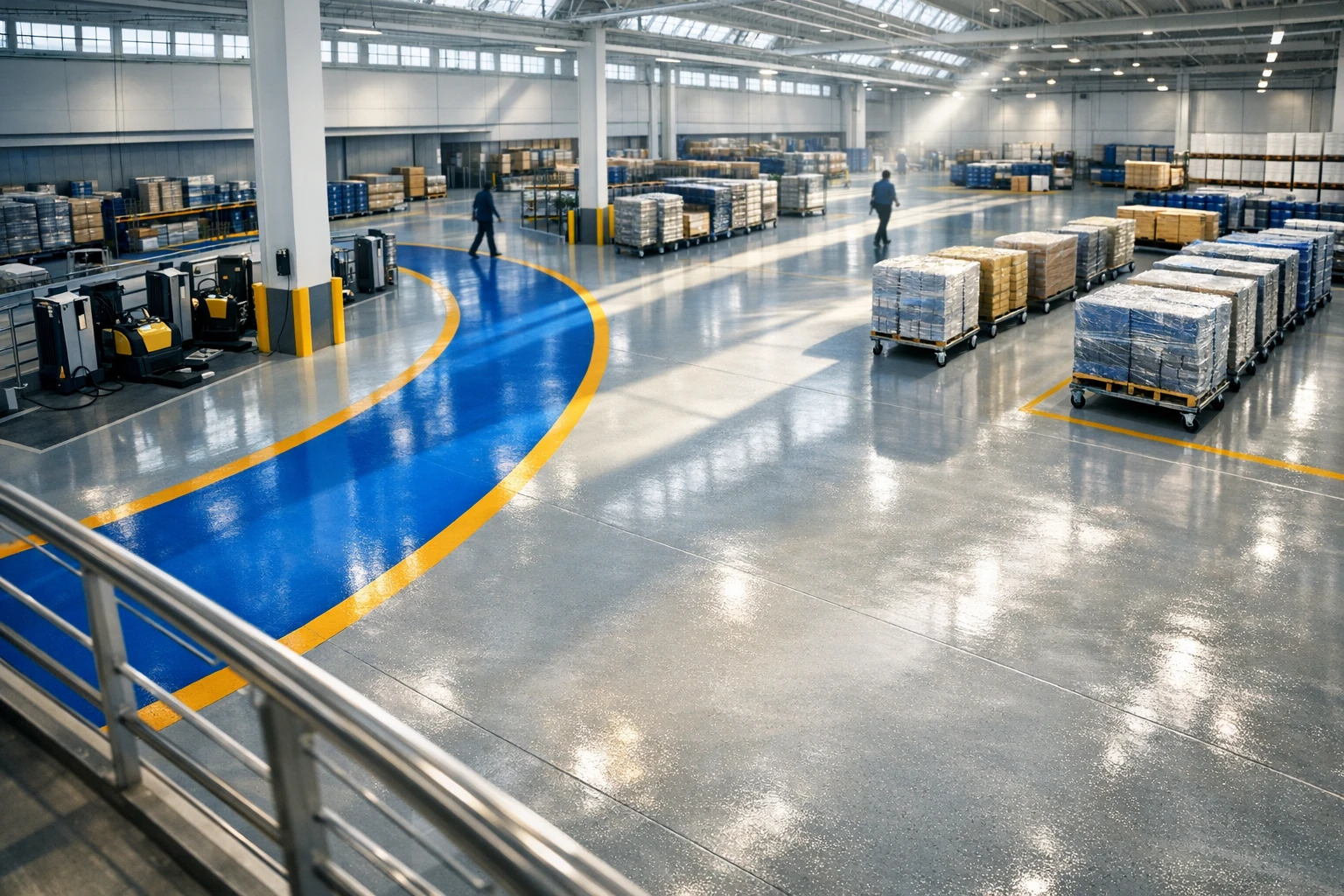
Industrial and institutional uses are even broader. Warehouses, mechanical rooms, production areas, laboratories, educational facilities, and healthcare-adjacent service spaces often need floors that are durable, hygienic, and clearly organized. Epoxy systems can support color-coded zones, pedestrian markings, and defined work areas, helping operations stay orderly. In some environments, additional properties such as chemical resistance, anti-static performance, or heavier build thickness become part of the specification.
Typical settings where epoxy is often considered include: • residential garages and workshops • commercial storage and service rooms • retail interiors and showrooms • warehouses and manufacturing support areas • schools, gyms, and public utility spaces
Still, epoxy is not the perfect answer for every location. Outdoor areas with intense sun exposure may require a different chemistry or a UV-stable topcoat. Slabs with uncontrolled moisture vapor can challenge adhesion. Historic or moving substrates may need more flexible systems. Fast-turnaround businesses may prefer coatings with shorter cure windows. These limits do not reduce epoxy’s value; they simply remind buyers to choose based on use conditions, not trend alone.
That practical fit is what keeps epoxy relevant. It works in spaces that need to be cleaned quickly, used heavily, or presented neatly, and it can do all three at the same time when planned well. Few flooring systems cover such a broad range without demanding completely different visual language from one building type to another.
Installation, Maintenance, and Choosing the Right Epoxy Floor
Selecting an epoxy floor is easier when you stop thinking only about color and start thinking about workload. The best question is not, “What finish looks impressive today?” It is, “What will this floor face every week for the next several years?” A family garage, a detail bay, a storeroom, and a light industrial workspace all ask different things from the same slab. Traffic level, moisture exposure, impact, cleaning chemicals, downtime limits, and slip concerns should shape the system choice from the start.
A typical installation sequence includes inspection, moisture testing, surface preparation, repairs, priming, the body coat, optional decorative broadcast, and a protective topcoat. Cure times vary by product and site conditions, but many systems need at least a day before light foot traffic and longer before vehicles or full service use. Temperature and humidity matter, which is why rushed scheduling can create preventable problems. A rushed floor may look fine at first and disappoint later. Patience, in flooring, is often cheaper than repair.
DIY kits exist, and some small residential projects can be handled by experienced homeowners. Even so, the biggest challenge is usually not rolling on the coating. It is preparing the slab correctly. Professionals bring grinders, moisture meters, repair materials, and the judgment to recognize when the substrate is not ready. That expertise becomes especially valuable in larger spaces or demanding environments where failure costs more than the installation itself.
Good maintenance is simple, but it should be consistent: • remove grit regularly so it does not act like sandpaper • wipe up oils, solvents, or chemicals quickly • use non-abrasive cleaning tools • place pads under heavy metal legs or equipment when practical • schedule recoating before heavy wear reaches the base layer
For homeowners, epoxy flooring can turn a garage or basement from an overlooked utility zone into a cleaner, more usable extension of the house. For business owners and facility managers, it can support easier maintenance, better presentation, and more predictable performance under daily pressure. For designers and builders, it offers a rare mix of practical discipline and visual freedom. If you are comparing options, choose the system that fits your traffic, your slab condition, and your cleaning reality, not just the one with the glossiest photo. That is the most reliable way to get a floor that still feels like a smart decision long after installation day.